|
QUINCY HOMESTEAD
Quincy, Massachusetts
17th and 18th
Centuries

Quincy Homestead
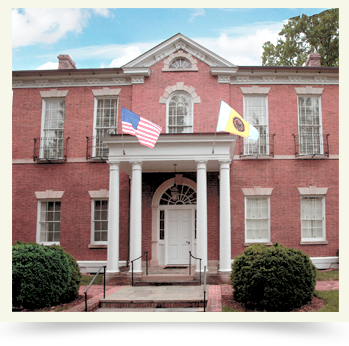
Recently designated a National Historic Landmark, the Quincy
Homestead is significant for its role in early American history, for its
architecture, and for its Quincy family association. The property, located at
the corner of Hancock Street and Butler Road, is part of the original land
that Edmund Quincy acquired for a farm in the 1630s. The present house,
dating from 1686, was enlarged and enhanced over a period of more than 200
years. Its majestic Georgian frontispiece and gambrel roof, with
distinctive dormer
windows, give the building a stately and substantial
appearance.
The Homestead served as a home for five generations of
Quincys, one of the leading families of Massachusetts. Their progeny include
President John Quincy Adams and Dr. Oliver Wendell Holmes. Leading up to
the American Revolution, the residence was a meeting place for many American
Patriots such as John Adams, Josiah Quincy and John Hancock. The house
was also the childhood home of Dorothy Quincy Hancock, the first First Lady of
Massachusetts, the wife of John Hancock, the president of the Second
Continental Congress, the first signer of the Declaration of Independence, and
the first governor of the Commonwealth.
The Quincy Homestead represents three architectural periods.
In 1686 the original kitchen area was built. In 1706 extensive additions
were made, and finally in the mid-18th century the current form emerged. It is
one of the few houses in Massachusetts in which the elements of a 17th-century
building are still clearly visible, although they have been surrounded by a
later style. The house is an excellent illustration of how architectural
styles developed during the colonial period.
|