|
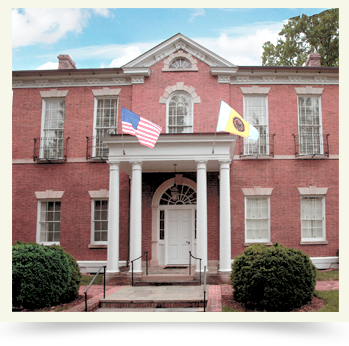
Trustee Emeritus Award for Excellence in the Stewardship of Historic Sites
In November 2000,
the National Trust for Historic Preservation presented this prestigious
award to The National Society of The Colonial Dames of America "for
acquiring, restoring, and interpreting a collection of historic properties
that offer invaluable opportunities to experience the rich variety of
America's heritage."
|
|
NSCDA in North Carolina Museum Properties
The NSCDA in
North Carolina owns four museum properties. Haywood Hall House and
Garden and the Joel Lane Museum House are in Raleigh; the
Burgwin-Wright
Museum House and Gardens is located in Wilmington; and The Fourth House
is in Winston-Salem.
|
|
HAYWOOD HALL HOUSE AND GARDEN
(1799)
Address:
211 New Bern Place, Raleigh, NC 27601
Telephone:
(919) 832-8357 and (919) 832-4158
Open:
March to Mid-December, Thursday:
10::30 am to 1:30 pm
Other times by appointment.
Directions:
From the Capitol,
downtown, follow New Bern Place east
for 1.5 blocks to the house.
Web site: http://www.haywoodhall.org
|

Photograph by Erik Kvalsvik |
|
This Federal-style frame house was
built by State Treasurer John Haywood for his family in 1799. Descendants
occupied the house until 1977, when the property and furnishings were left
to The National Society of The Colonial Dames of America in the State of
North Carolina.
It is the oldest house within the
city limits of Raleigh that is on its original site.
The gardens are both lovely and
functional. They, as the house, have been the site for numerous weddings,
receptions, and other social functions during John Haywood's time as well
as the present.
NATIONAL REGISTER OF HISTORIC PLACES
STATE HISTORIC SITE
RALEIGH HISTORIC SITE
ACCREDITED: NSCDA MUSEUM
PROPERTIES |
|
|
JOEL LANE MUSEUM HOUSE
(c. 1760)
Address:
P.O. Box 10884, 728 West Hargett Street, Raleigh, NC 27605
Telephone:
(919) 833-3431 (if no answer, leave
message and your call will be returned).
Open:
Tuesday through Friday:
10:00 a.m. to 2:00 p.m
Every Saturday: 1:00
to 4:00 p.m. Other times by appointment.
Directions:
From the state capitol, go west
on Hillsborough Street 7 blocks to St. Mary's, left on St. Mary's, 2 blocks
to Hargett Street. The house is on the corner of St. Mary's and West
Hargett.
Website:
http://www.geocities.com/joellane_raleigh/
|

Photograph by Erik Kvalsvik
|
|
The home of Joel Lane was built
on a knoll overlooking the future city of Raleigh. The little house
was the center of many historic gatherings; the gracious hospitality within
its walls witnessed the birth and growth of the capital of North Carolina.
Lane introduced the bill in the Legislature for the creation of Wake County
in 1770 and sold 1,l00 acres of land to the state of North Carolina in 1792 for the creation of the
capital city of Raleigh; hence he is known as the "Father of Wake County."
About 1790, Joel Lane remodeled
the house, and it is in this form that it is seen today. In 1927,
the house was moved approximately one block to its present location. The Wake County Committee of The National Society of The Colonial
Dames of America in the State of North Carolina purchased the house but
restoration was not completed until the 1970s. Many beautiful and appropriate pieces
were purchased for the house, some of which are believed to have belonged
to Lane or his children. The house is leased to The Joel Lane House,
Inc., a nonprofit corporation.
The grounds include a detached kitchen,
a formal city garden, and a period herb garden designed by Donald S. Parker
of Colonial Williamsburg.
NATIONAL REGISTER OF HISTORIC PLACES
RALEIGH HISTORIC SITE
ACCREDITED: NSCDA MUSEUM
PROPERTIES |
|
|
BURGWIN-WRIGHT MUSEUM HOUSE AND GARDENS
(1770)
Address:
224 Market Street,
Wilmington, NC 28401
Telephone:
(910) 762-0570
Open:
Tuesday through Saturday: 10:00
a.m. to 4:00 p.m.
Closed:
December 24 through January 31,
July 4, Labor Day, Thanksgiving (Thursday through Monday).
Directions:
From I-40, take Exit Highway 17
south (Market Street) to stop light, turn left and stay on Market Street
to South Third Street (approximately 3 miles). The house is located
at Third and Market in the historic downtown area.
Website:
http://www.ego.net/us/nc/ilm/tts/bwhouse.htm
|

Photograph by Erik Kvalsvik
|
| The Burgwin-Wright Museum House is a Georgian house with
a handsome Palladian doorway, double porches on two sides, and authentic
Colonial gardens on seven levels.
Built in 1770 for John Burgwin, Treasurer of the Colony
of North Carolina, it was purchased in 1937 by The National Society of
The Colonial Dames of America in the State of North Carolina for their
State headquarters.
The house has been carefully restored and a fine collection
of 18th- and 19th-century furnishings acquired. The separate kitchen
building offers demonstrations of open-hearth cooking and crafts.
This charming property creates a link with the past and
is an excellent example of a Colonial gentleman's town residence.
NATIONAL REGISTER OF HISTORIC PLACES
ACCREDITED NSCDA MUSEUM PROPERTIES |
|
THE FOURTH HOUSE (1768)
Address:
428 South Main Street, Winston-Salem. NC
Open:
Fourth House is part of the Old
Salem Historic Village. Even though the interior is not open for viewing,
visitors enjoying viewing the exterior which is one of the rare original
half-timbered buildings in this country.
|

Photograph by Erik Kvalsvik
|
|
Completed in 1768, the Fourth House,
as the name implies, was the fourth building constructed in the Moravian
village in Salem, North Carolina. It has the distinction of being
the oldest, original structure still standing in Old Salem restoration
area. Purchased in 1936 by the Forsyth Committee of The NSCDA in
North Carolina, through the generosity of several members, it was then
partially restored and stabilized. In 1963, more funds were raised
by Committee members and Old Salem agreed to complete the restoration.
Old Salem, Inc., currently leases the property from the Forsyth Committee
to a "worthy" tenant for a nominal fee and is responsible for the property's
management and upkeep.
The half-timbered construction typical
of the early Moravian dwellings was, according to Records from the Moravian
Archives, preferred to log construction as it resulted in a more stable
structure. In this process, the timbers were measured and each joint
was put into place, a wooden peg was hammered in at a right angle, locking
the parts together." The voids between the timbers were nogged with
soft brick and red clay mortar, the result of which can be clearly seen
in the accompanying photograph. The steep pitch of the tile roof,
ending with a slight "kick" at the eaves, the stone foundation, and lack
of ornamentation reflects a central European tradition which the early
Moravian settlers would have brought with them from their first settlement
in Herrnhut in Eastern Germany, near the Czechoslovakian province of Moravia
where they originated.
The Fourth House is one of the few
remaining half-timbered houses in this country.
NATIONAL REGISTER OF HISTORIC PLACES
ACCREDITED: NSCDA MUSEUM
PROPERTIES |
|