Trustee Emeritus Award for  Excellence in the Stewardship of  Historic Sites

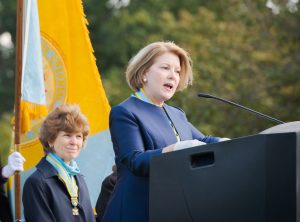
In November 2000, the National Trust for Historic Preservation presented this prestigious award to The National Society of The Colonial Dames of America "for acquiring, restoring, and interpreting a collection of historic properties that offer invaluable opportunities to experience the rich variety of America's heritage."


NSCDA in Rhode Island Museum Properties

The NSCDA in Rhode Island has two historical properties' projects in that state. The Governor Stephen Hopkins House is in Providence and Whitehall is in Middletown.


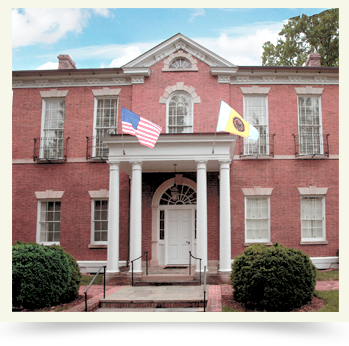
GOVERNOR STEPHEN HOPKINS HOUSE
(1708)

Address:  15 Hopkins Street, Providence, RI 02903

Telephone:  (401) 421-0694

Directions:  From I-95, take 195 East to 2nd Street Exit (Wickenden Street).  Follow signs.  Take immediate 2nd left under bridge, go straight to Benefit Street, and continue to Hopkins Street.  The house is on the SW corner.

Open:  Saturday-Sunday 1-4 p.m.

Web site: www.StephenHopkins.org


Photograph by Erik Kvalsvik

In 1743, Stephen Hopkins purchased a home supposed to have been built in 1708.  To the structure, Hopkins attached his own two-story house, built with a single ground floor room on either side of a central hallway and two chimneys (one for each main floor room with chamber above).  He installed a fine staircase with stocky balusters set in a heavy, molded closed string course, and good paneling and trim.  The handsome shell cupboard over the fireplace and the overdoor panels are similar to other homes built before the Revolutionary War.

The furnishings are similar to those Governor Hopkins is known to have owned.  Hopkins' own possessions on display include two Queen Anne chairs, his silver porringer, shoe buckles, baby bonnet, and shoes.

Governor Hopkins was one of the two Rhode Island Signers of the Declaration of Independence.  George Washington visited Hopkins in his house.

Alden Hopkins, a descendant of Governor Hopkins' brother, and resident landscape architect at Colonial Williamsburg designed the 18th-century parterre garden.

NATIONAL HISTORIC LANDMARK


WHITEHALL  (1729)

Address:  311 Berkeley Avenue, Middletown, RI 02842-5392

Telephone:  (401) 846-3116 or (401) 847-7951

Open:  Daily, July 1 through Labor Day: 10:00 a.m. to 5:00 p.m.  Other times by appointment.  Tours are welcome.

Closed:  Mondays.

Directions:  Three miles north of Newport on Berkeley Avenue, between Route 138 and Green End Avenue.

Web site:  www.whitehallmuseumhouse.org


Photograph by Erik Kvalsvik

Whitehall, built by the renowned philosopher, Bishop George Berkeley, and in which he lived while in America, was given in 1900 to The National Society of The Colonial Dames of America in the State of Rhode Island and Providence Plantations as a perpetual memorial to him.

Berkeley had hoped to establish a college in Bermuda for the purpose of educating colonists and native Indians for the ministry.  He bought 96 acres of farmland surrounding the house as a base of supplies for the college.  Failing to receive the promised funds from the Crown, he returned to Ireland, giving his entire holdings to Yale College.

The house is an unusual hip-roofed building with a long, sloping lean-to across the back and a Palladian doorway.  The colonial furnishings and the herb garden, designed and maintained by the Newport Garden Club, are in keeping with the period of 1729-1731 when Berkeley resided there.

NATIONAL REGISTER OF HISTORIC PLACES
ACCREDITED:  NSCDA MUSEUM PROPERTIES

Email: info@nscda.org
Last updated:  10/26/2009
©2003-2005 The National Society of The Colonial Dames of America